Thursday, January 13, 2011

Horns on humans. For real.

"Doctors say they don't know what caused it," Huang Yuanfan of China tells the press, "But if they try to take it off it will just come back." Yuanfan is 84 years old and lives in Ziyuan, China. The it he's referring to turns out to be a three-inch horn growing out the back of his head.

Seriously? Yes. Seriously.

What started out as a small lump, Yuanfan attempted picking at it and even tried filing it off. Nothing worked, however, as the protrusion continued to grow.

In fact, this has happened before. More than once. Last year, a 101 year old Chinese woman made headlines with not one, but two horns growing on her head. The second horn, in its earliest stages, is shown here. A mother of seven, her family expressed worry.

During the same year, another Chinese woman made the news with a 6 1/2 inch horn growing out of her forehead. The horn curled down over her face and was growing for 4 years. Another similar case occurred in 2006.

Human horns are not limited to China it seems. In Yemen, 2007, a 102 year old man named Saleh Talib Saleh was reported in the Yemen Observer to have grown a horn at age 78.

"One day, as I was touching the surface of my head, I felt a very thick and hard layer of substance on my head," Saleh told the Yemen Observer. "At that time we didn't have the medical institutions like we have today, so I ignored it and did not focus too much on it because it didn't bother me at all. Every week, it seemed to grow bigger and harder."

In this particular case, the individual broke the horn off once it reached 19 inches long in 2006. Only days afterward, the growth continued.

Each of the horns resembles what is called a cutaneous horn, a funnel-shaped protrusion that are usually only a few millimetres long. Cutaneous horns are composed of compacted keratin, which is the exact protein we have in our hair and nails which forms horns, wool and feathers in the animal kingdom. The underlying causes of cutaneous horns are the common wart, skin cancer and actinic keratoses, sections of scaly skin that develop on skin heavily exposed to the sun - in these cases, the face and head. Doctors do acknowledge that the length of the horns mentioned here are unusual.

Aflockalypse: The Debate Continues Over Mass Animal Deaths

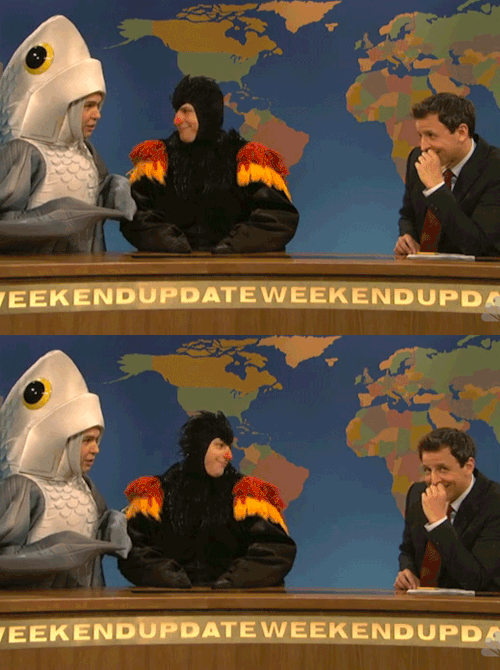
The term Aflockalypse, a term referring to the mass animal die-offs occuring early in 2011, got started with conspiracy theorists and became a laughing matter with Saturday Night Live (see photo).

No laughing matter, however, is the fear and debate resulting from the seemingly unending reports of mass animal deaths occuring the world over since New Years Eve 2010.

Just yesterday, California reported about 100 birds died and were found near Highway 101 near the Wine Country region.

So far the public has been presented with many rational explanations for the mass deaths such as cold weather, movement of the earth's magnetic pole, blunt trauma, H1N1, disease and fireworks. While scientists are continuing to examine dead birds in the US, conspiracy theorists are busy tying loose ends together. Government testing, the end of times. Some really complex theories have tied the murder of John Wheeler in Delaware earlier this year to a WMD cover-up related to the animal deaths.

Fact is, over ninety mass animal deaths have been recorded over the past year and that's basically normal. The problem is that we're so tied to our cell phones and computers and the incoming news seems like something we've never heard before - because we've never heard it before!